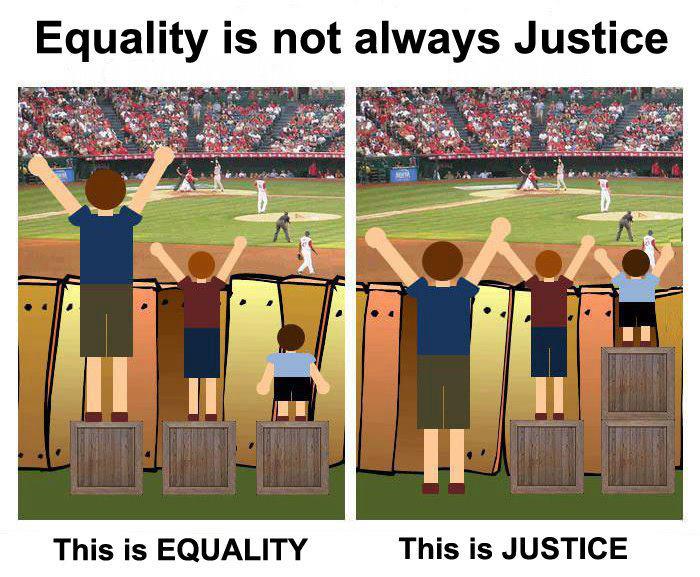
Equality is not always justice. Image from Imgur: http://imgur.com/gallery/HYx95Xk
This semester, I am very happy to be participating in a course entitled “Social Justice in the Information Professions.” The class isn’t part of my required/needed courses to fulfill my certificate of advanced study (CAS) in digital libraries (DL). Social justice and service to diverse, underserved populations through programs and community engagement activities are things I deeply care about, professionally and personally.
Our class today focused on global development and social justice, as well as community engagement and community-based research. We had a lightning round of article reviews, in which students discussed an article they read outside of class. The discussion needed to be limited to just 2-3 minutes of summary and analysis. The articles had to be about global development, community engagement, community-based research, and/or social justice. They need not be about library services, but all of us opted for some information-related topic.
There were a lot of articles cited by my classmates this afternoon that I want to read on my own. As for me, the article I decided to share was on Open Access and criminal justice scholarship, entitled “Open Access to Criminal Justice Scholarship: A Matter of Social Justice.” It was published in 2008 by Allan Scherlen and Matthew Robinson in the Journal of Criminal Justice Education, 19(1), pp. 54-74.
The essence of the article is the position of the authors that practices in the scholarly publication world, specifically those that affect the criminal justice scholarly discipline, are not aligned with the principles of social justice. The authors discuss the positions of John Rawls and David Miller, two authors/thinkers who have greatly influenced what we have come to recognize as social justice philosophy and theory. Much of Rawls’ and Miller’s theories rest on principles of fairness and equality. I personally found this discussion illuminating. While equality and fairness are principles we can safely assume as important to achieving social justice, Dr. Nicole Cooke framed our social justice course by introducing us to the accompanying image, which states that “equality is not always justice.” They do seem to have a lot in common, but we need to recognize that this is not always so.
When are the times that equality and fairness clash with justice? Scherlen and Robinson’s article offers a clue, pointing to an answer to this question. Rawls’ difference principle, and Miller’s need and desert principles, consider the existence of inequality. They just happen. However, Rawls’ social justice theory states that these differences should be skewed toward the benefit of the least advantaged among us. In short, take a look at the image in this post. That. It says a heck of a lot.
I feel I have a lot still to understand. But for now, I have come to see that the goal isn’t equality. Not really. Equality is only an attribute, a mark or sign that we look for along the way to achieving the true prize–justice.
Have thoughts? I’d love to read them in the comments.


You must be logged in to post a comment.