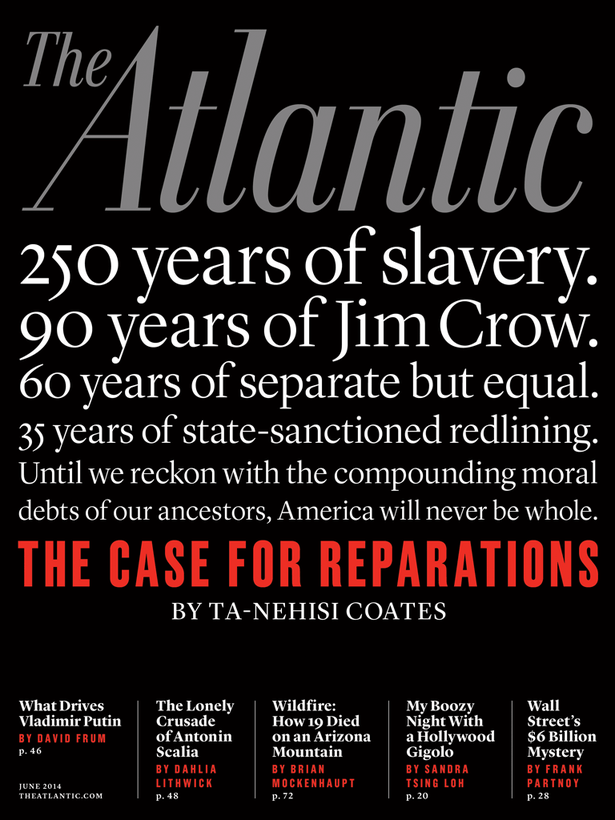
So before you react, at least understand these two things about Coates’ article:
It’s not just about slavery.
He’s not saying, “All you white people need to send me a check.”
So before you react, at least understand these two things about Coates’ article:
It’s not just about slavery.
He’s not saying, “All you white people need to send me a check.”
Knowledge + Alliance Initiative: Essential Information Workshop – Los Angeles
On Friday and Saturday, May 30-May 31, 2014, I will be traveling to Loyola Marymount University to co-host the two-day Essential Information Workshop-Los Angeles (EIW-LA). For the past couple of months, I have been working as the Curriculum Coordinator and conducting collaborative work with Gwendolyn Prellwitz, Assistant Director of the American Library Association’s Office for Diversity, and Jennifer Masunaga, Loyola Marymount University Reference and Instruction Librarian and EIW-LA Logistics Coordinator.
The work we have been doing to develop the EIW-LA event has been the most rewarding, most exhilarating part of my career as a librarian to-date.
Connected to this is a poster proposal that I am working on with Isabel Gonzalez-Smith, Coordinator for EIW-Chicago, to participate in the Library Research Seminar VI at the University of Illinois at Urbana-Champaign. I hope our proposal gets accepted!
After the EIW-LA events, I will be looking ahead to attending ALA Annual 2014 in Las Vegas, Nevada. The Knowledge Alliance Initiative will figure prominently in my plans and attendance at this year’s ALA Annual Conference, though I still need to finalize all the specific events I am obliged to attend. And the ones that I prefer to attend on a just-because-I-want-to basis. Of course, hanging out with people I love are high on the priority list! As are hearing Dr. Jane McGonigal, Stan Lee, Lois Lowry and Jeff Bridges, B.J. Novak and Azar Nafisi. In Conferences past, I had prioritized work and obligations over networking, socializing, and my own personal knowledge and learning. This time, I am hoping I will be able to see all the speakers I intend to see.
Because my dear spouse and our youngest child will be coming along, and we will be staying till the morning of 4th of July, I will be making a point of enjoying time and sun with them. OT: Our oldest child will be going with her theater group to Ashland, Oregon for the annual Oregon Shakespeare Festival. We’ll do something fun and with her when we get back from the conference.

Twitter Responds To Santa Barbara Shootings With #YesAllWomen Hashtag.
Because my daughters will grow up to be women #YesAllWomen

Archimedes: “Give me a place to stand and I will move the Earth.” Image credit: TMF Associates MSS blog
Archimedes‘ work on levers is astounding. Though he didn’t invent the lever, he did describe the principles behind it, explained why and how it worked. Archimedes, one of the greatest scientists and mathematicians of antiquity (and perhaps of all time), likely did not intend the sociopolitical application of his words. He was talking about natural physics, not social or political principles.
And yet… it fits so well.

Leverage: Alignment Chart. By Scavgraphics From DeviantART
As the television show on TNT Leverage tried to demonstrate, money and prestige offer a particular power that is beyond the reach of people with less money and prestige. When faced with such obstacles and odds what are we, then, to do? You’d think that the law is a means of providing some equalizing leverage, right? Unfortunately, that doesn’t always work.
While money and prestige are a type of sociopolitical leverage, the show also demonstrated that having faith and belief in people is entrusting them with leverage. That is, leverage in the sense of “a place to stand” in order to “move the world.” Shaking off labels can be very difficult. Though you may try to resist them, they inevitably leave their mark. Sometimes, you don’t even need others to confirm or deny the power labels have over you–generally speaking, you can more than capably fill the role ascribed to you.
 This power over one is, in fact, the most insidious, damaging, and dangerous aspect of stereotypes. Combined with the categorization of people according to worth, stereotypes can be downright lethal. Nevermind that there are a few ounces of truth within each stereotype. Untempered, the bad simply outweigh the good.
This said, people who give others a place to stand, who provide others with leverage, should be commended. They are enabling others to move the world.
Personally, this is the sort of thing that I think about when I recall the opportunities given, and denied, to me and the people I know well. I make lists, actual and mental ones. Like Santa Claus. In no particular order, I write down and recognize who has given me a place to stand and who has denied me a place, a voice, an opportunity. I’m sure I’m not the only one who does this.
The goal is to keep the lists empty–pay debts, forgive, and move on.
 While I work to keep these lists empty, I do remember. In either case, I am provided with fuel for the fire. Motivation.
To those who have believed in me: by giving me a place to stand, I recognize your faith in me and seek to make you rest easy. I know you gambled on me and I will repay. Loyalty.
To those who have thought it wise to not give me a chance, whether deserved or not: I won’t forget.
“Barbara Jones, director of the ALA Office for Intellectual Freedom, said she has received requests from many younger ALA members over recent years who want to understand what happened in 1977 and want to revisit the controversy with a 21st-century perspective. “I remember my first term paper at Columbia University’s School of Library Service (1977) was about ‘The Speaker’ controversy. It is an issue still with us today when it comes to speech that most of us hate to protect or endorse. We plan to give ALA membership ample opportunity to express their opinions about this issue before, during, and after the conference, because it is complex and important.”
“The debate over the limits of free speech has always been incendiary,” said Judith Platt, director of free expression advocacy for the Association of American Publishers. “For those of us in the book community it is crucial to understand the history and context within which that debate has taken place. This program on ‘The Speaker’ and it’s attendant controversy will provide an excellent forum to deepen our understanding.””
ALA members to discuss controversial film ‘The Speaker’ at Annual Conference | News & Press Center.


Kindness. Image from Feb. 19, 2007 article in The Age. Illustration by Michael Leunig.

“Put away from you all bitterness and wrath and anger and wrangling and slander, together with all malice, and be kind to one another, tenderhearted, forgiving one another, as God in Christ has forgiven you.” Ephesians 4:31-32, NRSVCE.
We generally equate niceties with kindness. As common pleasantries are the easiest, most readily observed manifestations of kindness, it’s easy to think of niceness and kindness as synonymous, if not one and the same.
I offer that niceness and kindness (and civility, for that matter) are not one and the same. They have some areas in common, sure. These are aspects that overlap, but don’t indicate sameness.
Reading up on the differences between niceness, kindness, and civility, a pattern focused on intentions emerges. The problem I have with this is that people don’t really wear their intentions like a visible sign on their heads (or anywhere else that we can examine, touch, and point at). Especially during brief, nano-seconds encounters, we won’t catch a glimpse of the other person’s intent. How then can I know if they are just “being nice” vs. “being kind”?
A friend whom I greatly admire and love is one such person I think of when as the embodiment of kindness and niceness. However, you’re only lucky to catch a glimpse of such qualities after you have gotten to know her better. To unknown elements she is the embodiment of civility. She is still pleasant, a bit detached, but polite and respectful. Once you get to know her a bit more, and she gets to know you, she is both kind and nice.
Which brings me to the commonly held stereotype of kindness and niceness–that such a pleasant, compassionate demeanor is equivalent to weakness. Taking my friend again as an example–I would not call her weak. Her approachable persona, her helpfulness and cooperativeness, and her slightly irreverent and biting sense of humor and wit seemingly belie her strength of character and will. She’s fun to be around and a great, wonderful person to have your back when the going gets tough, but she is equally principled, determined, and has a high standard of work and behavior.
She inspires me to be a better person. Ultimately, the ability to inspire others to be their better selves through positive means is, I think, the essence of kindness. To be able to do this, however, involves the ability and willingness to listen to and put another person and their concerns ahead of one’s own. Niceness is the behavioral manifestation of kindness. I think this is why we often equate both. They are linked, but not the same. A person can be nice without being kind. Conversely, a person can be kind without being nice, at least not all the time.
Sometimes we justify tough-love actions as kindness. I hear “you have to be cruel to be kind” quite a bit. I don’t buy it. Sure, there are times when a person needs to deliver some unpleasantness for the sake of a larger goal. As a parent, this is something I know very intimately. However, being kind also means acknowledging the effects of the unpleasantness one needs to deliver. I don’t mean putting on a sad face and body language, either. There are consequences for not being nice that affect others to such an extent that the course of their lives are altered. Being truly kind doesn’t mean one shouldn’t deliver unpleasant news at all. It means understanding that how one personally feels is a distant second to how the other person feels.
What does this, kindness vs. niceness, have to do with advocacy? I see kindness and compassion as foundational values of advocacy. In advocating for information literacy, community, diversity, inclusion, education, and privacy, I see kindness as an underlying ethic that states “people first.” Civility, in my estimation, is the baseline of decorous dialogue we need to live and act in a multicultural, multiethnic democratic society. We need to be able to talk to each other, find ways to demonstrate and connect to each other in ways that demonstrate our feelings and value for human kindness. As far as I am concerned, to be kind is to be human…and to recognize others as human, too.
If we can’t even have the conversation he wants because people are so defensive or unwilling (or plain racist), it’s just more evidence for what his essay rightfully bemoans.
via On Ta-Nehisi Coates’ Atlantic Magazine Slavery Reparations Essay | New Republic.
This article from the New Republic’s Isaac Chotiner reminds me, yet again, why discussions about race, equity, inclusion, and diversity are very important. As an active member of the American Library Association (ALA), and a librarian who deeply, deeply cares about social justice and diversity, I hope we are coming to terms with our own type of reckoning within American librarianship through ALA.
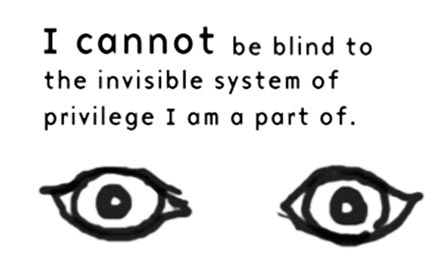
“Check your privilege” isn’t a demand to apologize for your structural advantages, it is a plea to stop and think about them; to see them, and acknowledge them, and consider whether it might be worth taking them apart. Far from being a progressive perversion of the liberal arts, thinking about structure is foundational.
via Check Your History – The Conversation – Blogs – The Chronicle of Higher Education.
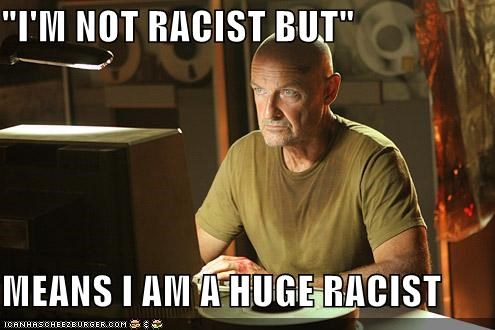
“Since folks believe that racists are monsters, and most people aren’t likely to be incontrovertibly monstrous, few people could ever qualify as racist.”
via Donald Sterling Says He Isn’t A Racist. Is Anyone? : Code Switch : NPR.
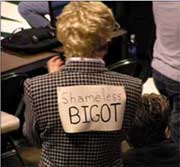
Bigots don’t wear labels or signs. Image credit: DesertPeace.
A person I am coming to admire asked me recently if I have ever been warned of being pigeon-holed as “the diversity and inclusion” person. No, I haven’t been, but I have thought about it. Long and hard. I have also heard others voicing their concerns about being type-casted as such. Personally, I feel that it’s a label I’d proudly wear. Not that I don’t have issues about this train of thought, especially since I think diversity and inclusion are not niche matters.
In a previous post I asserted that social justice, diversity, and inclusion work is equivalent to working for belonging, as in belonging as described by Abraham Maslow’s hierarchy of needs. In no way do I suggest that there aren’t any basic, fundamental, life-death sorts of struggles that are involved in social justice work. Not at all. We are all too aware of how essential needs are denied people because of characteristics they may have that have been labeled by others as less desirable, more dangerous, less worthy. The seeds of this ranking of people from good to meh to deviant/pathological/undesirable are things we are all caught up in, whether we decide to acknowledge them or not.
Life and social justice work would be so much more easier if bigotry (and bigots) wore labels and signs, maybe a scarlet letter, for everyone to see. But, obviously, they don’t. Besides, other-ing bigots and bigotry might not be the best tactic.
Since we’re all products of our environment, it’s really important to acknowledge the effects of inequity within our society and within ourselves. This, however, requires us to accept that awareness and acknowledgement are fundamental to being decent human beings. Let’s face it, this type of internal work is exhausting, frustrating, and not at all fun. Confronting one’s own shortcomings and personal bigotry is extremely difficult. What to do? I’m not sure. I’m trying to figure that out myself.
While I’d really like to not be pigeon-holed (and consequently overworked and burnt-out), I believe social justice work is of utmost importance. It is fundamental to our communities, our society, and, heck, very likely, our civilization. Suffice to say, it matters a lot. It is work that makes a difference in the lives of individual people and to our increasingly multicultural, multiracial society. If subsequently becoming pigeon-holed is the consequence of the work I am currently doing, I gladly accept. Really, it’s a very small price to pay.
However, social justice workers need trustworthy, loyal, committed allies and friends. Better yet, coworkers, comrades, and companions. The tasks that need to be undertaken are huge. And, oftentimes, the path leading to our goals of equity and inclusion is narrow, treacherous, and lonely.
Of late, I am learning that people who say they are pro-social justice are actually people who just say they are, believing they are competent allies because they’ve checked boxes off of a list or have sympathies for the truths committed people declare. But working for social justice is something that requires repeated action, demonstration, and a hefty share of sacrifice. When commitment exacts a big-enough price, the rationalizations and justifications abound. How do we know who are the truly committed and who are paying lip-service? There’s no easy, singular answer to this question. Membership in a disenfranchised or underrepresented community doesn’t preclude one from this question, either. Personally, I think we should all be asking ourselves this question repeatedly.
The checking we are so often invited to do is not the checking off of items on a list. It’s actually the internal checking of one’s own personal views, beliefs, strengths, and flaws. The focus is on the process, not necessarily the product. Labels and signs don’t work for these sorts of things, unfortunately.

You must be logged in to post a comment.