social justice

We seek to radically reshape and remake the institution in more equitable ways. True solidarity cannot pay lip service to feminist, de-colonial, anti-racist projects while maintaining individual investments in a system that works for only the most privileged bodies. Marginalized individuals cannot but participate in the oppression of other marginalized people if they are invested in academia’s current structure. Increased “representation” merely reifies the system rather than expands the possibilities for solidarity, for change.
“I Have A Cultural Studies Degree” Is the New “I Have Black Friends” — The Archipelago — Medium.

“Your degree, your reading list, your completion of a single course at a university can’t automatically make you my ally. Allyhood requires action and understanding. Tell me you’re my ally, and I’ll ask you how you work to end racism and sexism in your everyday life. You can’t dismantle systems of oppression by reciting Angela Davis quotes.”

IDIC via Photobucket
This past Monday, June 30, 2014, The ALA Special Presidential Task Force on Equity, Diversity & Inclusion had its first, albeit informal, gathering. The Task Force (TF) was convened as one means of responding to BCALA’s statement denouncing the American Library Association’s decision to hold the 2016 Annual Conference in Orlando, Florida.
The meeting consisted mainly of each member of the TF getting to know the others in a casual, self-directed atmosphere, creating a safe space for talking about differences and the issues we are meant to address, and figuring out what our immediate first steps are supposed to be. This approach goes a long way toward building consensus, which we will definitely need later on.
I personally find the issue before us very daunting. I shrink before it. The decision of the TF co-chairs to establish our first meeting as a conversation, intent on honoring and acknowledging each member’s humanness and good intentions, made my anxiety subside some. The charge, “we will change the world,” became exciting and not so scary. I feel I can trust the process, my co-members, or, at least, the co-chairs of the TF.
When we parted, one of the co-chairs mentioned that the hotel where we had our meeting–the Las Vegas Hotel, formerly known as the Las Vegas Hilton–was home to Star Trek: The Experience for the entire 10 years it existed. How appropriate. IDIC should be our TF motto.
Fast forward to this past Friday, July 4, 2014. The birthday of the United States of America. I have complicated feelings about this holiday, the American patriotism and nationalism on display, and my living in this nation. When I became a naturalized citizen over 10 years ago, I swore to defend the Constitution of the United States, its laws, and defend its existence as a nation, “without any mental reservation or purpose of evasion.”
What wasn’t part of that oath is what people like me are getting in return for our allegiance. There are still moments when I feel like I am not so loved or wanted by my adopted nation. Even though I am obliged to defend it with everything I hold dear, including my life, I feel I can not, should not, expect anything more in return. It’s enough that I got this nifty plastic-and-polyester flag, an ornate certificate, and a passport that will pretty much grant me entry into a lot of ports. Right?
I’m with Uncle George. The things I got during the Naturalization Ceremony are mere tokens. The true prize is the responsibility of being an American citizen.
American democracy is vitally dependent on good people who cherish the ideals of our system and actively engage in the process of making our democracy work.
I say the same goes for the work we need to do within ALA. As I became, and remain, a librarian because of the ideals of the profession, I am vitally concerned about its living up to its founding ideals. Let’s work together to make this so. Live long and prosper.
The revolution WILL BE LIVE. ~ Gil Scott-Heron
Recent events have caused me quite a bit of dismay. But as Gil Scott-Heron says, the revolution will put us in the driver’s seat. So, where do we want to go?

Do not allow white critics to assert their privilege and demand that you shift the conversation to smoother terrain, one which allows them to ignore their own complicity in the systems that continue to oppress people of color. Allow no one tell you that your work is not important. Write, research, and teach with revolutionary rage, as if the very future of this country depends on it. Because it does.
via How Race-Studies Scholars Can Respond to Their Haters | Vitae.
I’ve also encountered people of color who are complicit in this white-supremacist narrative. Are they included in this? I think so.

Twitter Responds To Santa Barbara Shootings With #YesAllWomen Hashtag.
Because my daughters will grow up to be women #YesAllWomen
“Barbara Jones, director of the ALA Office for Intellectual Freedom, said she has received requests from many younger ALA members over recent years who want to understand what happened in 1977 and want to revisit the controversy with a 21st-century perspective. “I remember my first term paper at Columbia University’s School of Library Service (1977) was about ‘The Speaker’ controversy. It is an issue still with us today when it comes to speech that most of us hate to protect or endorse. We plan to give ALA membership ample opportunity to express their opinions about this issue before, during, and after the conference, because it is complex and important.”
“The debate over the limits of free speech has always been incendiary,” said Judith Platt, director of free expression advocacy for the Association of American Publishers. “For those of us in the book community it is crucial to understand the history and context within which that debate has taken place. This program on ‘The Speaker’ and it’s attendant controversy will provide an excellent forum to deepen our understanding.””
ALA members to discuss controversial film ‘The Speaker’ at Annual Conference | News & Press Center.

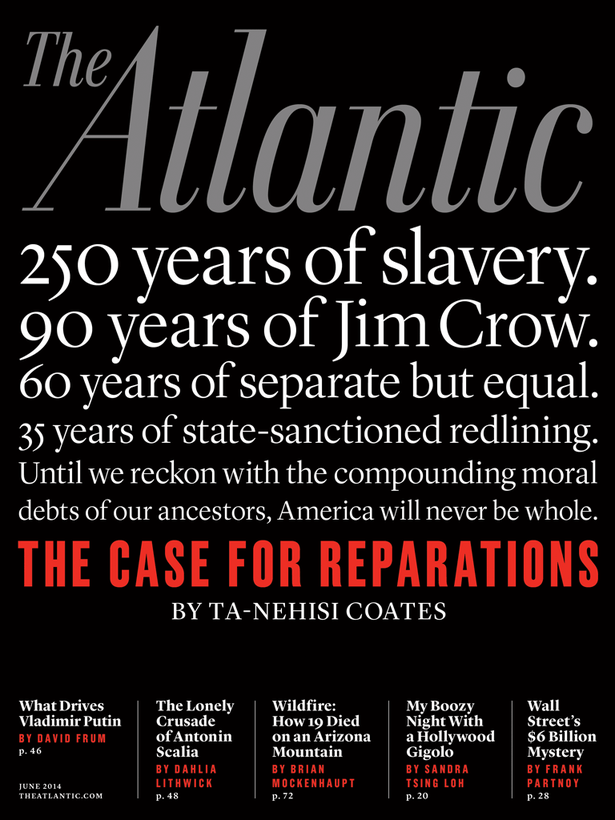
If we can’t even have the conversation he wants because people are so defensive or unwilling (or plain racist), it’s just more evidence for what his essay rightfully bemoans.
via On Ta-Nehisi Coates’ Atlantic Magazine Slavery Reparations Essay | New Republic.
This article from the New Republic’s Isaac Chotiner reminds me, yet again, why discussions about race, equity, inclusion, and diversity are very important. As an active member of the American Library Association (ALA), and a librarian who deeply, deeply cares about social justice and diversity, I hope we are coming to terms with our own type of reckoning within American librarianship through ALA.
You must be logged in to post a comment.